Wednesday, 27 October 2010

The world’s industrial catastrophe- the Bhopal gas disaster

 As you will notice my previous post was for corporate crime! When I did my research the Bhopal gas disaster took my attention. I didn’t know or heart anything about it before, I was not even born that time but this is not an excuse! We must be informed of these extremely huge disasters even If they are two thousand years ago because most importantly such disasters as the Bhopal one has to do with human lives! However we could inform our selves by searching. From what I found from my research, I will now talk and inform you about this disaster.


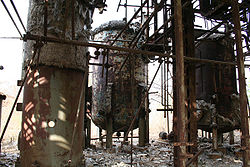
The world's worst industrial catastrophe  is the Bhopal gas tragedy.  It happened on the night of December 2–3, 1984 at the Union Carbide India Limited (UCIL) pesticide plant in Bhopal, Madhya Pradesh in India. A leak of methyl isocyanate(MIC) gas and other chemicals from the plant resulted in the death of several thousands of people.

Estimates of the death toll vary greatly. The official immediate death toll was 2,259. The government of Madhya Pradesh has confirmed a total of 3,787 deaths related to the gas release.[1] Other government agencies estimate 15,000 deaths.[2] Some approximate that 3,000 died within weeks and that another 8,000 have since died from gas-related diseases.[3]  In 2006 a government affidavit stated that the leak caused 558,125 injuries including 38,478 temporary partial and about 3,900 permanently and severely disabling injuries.[4]  You could understand from these estimates the great and very huge size of the disaster. Is very problematic and I could say what happened was inhuman.

The UCIL factory was built in 1969 to produce the pesticide Sevin using methyl esocynate (MIC) as an intermediate. A MIC production plant was added in 1979. Mr Y P Gokhale, the managing director of  Union Carbide in India, stated that Mic Had escaped when a valve in the plant's underground storage tank broke under pressure. As a result a deadly cloud of lethal gas float from the factory over Bhopal.


Bhopal is home to more than 900,000 people who many of them live in slums. Now you could understand or figure the size of the disaster. Its obvious that chaos and panic prevailed in the city. Ten thousands of people attempted to escape. Thousands of cats, dogs and cows were dead on the streets. More than 20,000 people have required treatment for symptoms such as frothing at the mouth, swollen eyes and breathing difficulties. Estimates claim that 50,000 people were suffering from terrible side-effects, blindness, kidney and liver failure. Campaigners stated that nearly 20,000 other have since died from the effects of the leak. Many woke up only because they heard their children coughing. As people jumped up from their beds, they felt their eyes and throat burning. Other feel to the ground in contortions of pain. People ran and ran, but they didn't know in which direction to go. Families were split in the confusion. Many people fell to the ground unconscious.

Ahmed Khan, the Bhopal resident said: "We were choking and our eyes were burning. We could barely see the road through the fog, and sirens were blaring. We didn't know which way to run. Everybody was very confused. Mothers didn't know their children had died, children didn't know their mothers had died and men didn't know their whole families had died."

One of the worst parts of this tragedy is actually what has happened in the years following. The company immediately tried to detached itself from legal responsibility. They claimed that they were not liable for any damages because they blamed a saboteur for the disaster and claimed that the factory was in good working order before the gas leak. . Ultimately it reached a settlement with the Indian Government through mediation of that country's Supreme Court and accepted moral responsibility and paid $470 million in compensation. This is a quite small amount based on the large underestimations of the number of people who have been exposed and of the long-term health consequences as many of the victims are unable to work and continue to live in ill health.

·                                                                                                                                                                               The penalty
The Union Carbide factory was closed immediately after the accident and three senior members of staff arrested. Medical and scientific experts have been dispatched to the scene and the Indian government has ordered a judicial inquiry. Civil and criminal cases are pending in the United States District Court, Manhattan and the District Court of Bhopal, India, involving UCC, UCIL employees, and Warren Anderson, UCC CEO at the time of the disaster. In June 2010, seven ex-employees, including the former UCIL chairman, were convicted in Bhopal of causing death by negligence and sentenced to two years imprisonment and a fine of about $2,000 each, the maximum punishment allowed by law. An eighth former employee was also convicted but died before judgment was passed.

However, since the disaster, India has experienced industrialization. Some behaviors of new industries and positive changes in government policy have taken place. But major threats to the environment from poorly regulated industrial growth remain. Widespread environmental deprivation with significant adverse and human health consequences continues to occur in India.

As I said in the beginning what happened was inhuman! I saw many photos on Google from the disaster and honestly what happened was not only inhuman but also “MORRALY UNACCEPTABLE”. For me such mistakes are not allowed in the world of industry and must be punished NOT ONLY BY FINES; I may be a bit strict about that but we must reconsider the penalty that the law imposes to such cases. We are talking about human lives, THOUSANDS OF HUMAN LIVES! We are talking about families, children, mothers, fathers, even dogs and cats! These are lives too!  I will close with the quote “No more Bhopals” for the good of the humanity! But if you read this I want you to set a question to yourself.   If this will happen to you, to your country, to your family what are your feelings going to be?? What you will do about this?? You are going to live it happen to you? Because if you don’t do anything about this, be sure this will happen again may be not to you but in other peoples life. 

Further reading:


Sunday, 24 October 2010

Corporate crime & White-collar crime

Corporate crime


Corporate crime refers to crimes committed by individuals who may be identified with a corporation or other business entity. Corporate crime involves acts like environmental pollution (corporate crime, such as the 1985 Union Carbide accident in Bhopal, India), fraud, dangerous work environments and making of unsafe products. Environmental crimes often result in death, injury and disease. A recent example of corporate violence is that of the 12 New Mexico campers who were killed in August 2000 when a natural gas pipeline operated by El Paso Natural Gas Co exploded near Carlsbad and more than 100 Americans have died in crashes linked to Firestone tire separations that caused their Ford Explorer vehicles to crash. Dr. Troyen Brennan, a leader of the Harvard University Medical Malpractice Study of New York State, stated that there are 100,000 deaths each year from hospital-based medical negligence.  Thus, a huge number of people die every year on the job or from occupational diseases such as asbestosis and black lung. Job deaths often result from criminal recklessness. They are sometimes prosecuted as homicides or as criminal violations.


White-collar crime

Edwin Sutherland defined white-collar crime as "a crime committed by a person of respectability and high social status in the course of his occupation". Some examples of white-collar crime are the blackmail, the bank fraud and credit card fraud. White collar crime is a category of criminal offenses that occur in corporations or business. Examples of white- collar crime are the insider trading, the antitrust violations, the computer fraud, the securities fraud and the money laundering. However, White-collar crimes are non-violent in nature, and generally involve some form dishonesty or fraud


What Businesses could do to prevent White Collar Crime?

Businesses can impose safeguards, to check on the conduct the employees. By making sure that records are preserved and by launching an internal investigation they could respond to allegations of wrongdoing. In order to ensure that employees are not engaging in unauthorized transactions they could audit banking activities.

A business that does not respond appropriately to criminal activity it could appear to be involved in that activity. If a business does not wish to be held responsible for illegal conduct the best way of doing so is to cooperate with any investigation of the wrongful conduct.


The punishment


A business could be punished only in financial terms for example by imposing fines so large that the business is forced to close down. It is also possible to impose a term of "probation," during which the business can be carefully monitored by the court. However, it is not possible to impose a "corporate death penalty" as the corporation is not an individual but a legal entity.

 Corporate crime – Damage on society

 My opinion is that corporate crime inflicts a huge and enormous damage on society than all street crime combined. Corporate crime poses a significant threat to the welfare of the community. The potential for both economic and physical harm caused by a corporation is great given the pervasive presence of corporations in a wide range of activities in our society, and the impact of their actions on a much wider group of people.


Further reading:


Is fairtrade fair?


WFTO and other cooperative initiatives claim that their aims are to ensure and promote better trading conditions[1], social justice[2] and protect the rights of wrokers and producers.[3] They seek to offer workers and farmers access to a better livelihood and better working conditions[4]. In order to implement these objectives fairtrade is using several rules such as a strict certification procedure that includes standards such as environmental support, better working conditions based on corporate social responsibility[5], a price premium to benefit producers and a fixed price of produce[6].However a great debate and controversy surrounds fair-trade.

 Some claim that under the FLO rules a farm needs to exploit in its agenda to part time working instead of hiring full time workers in order to qualify as fair trade. This means that part time workers do not have the same rights with full time workers.[7]Although, there have been various reports of horrible working conditions with some of the farmers alleging not having knowledge of the entitlement of a premium.[8] Fair trade is also criticised that instead of helping problematic farming communities in changing their ways they guarantee a fixed price usually higher than the market average holding them back from developing.[9] Although, evidence supports that the premium policy is not effective.

Moreover, many critics support that fair trade is trying to create a ‘guilty conscience’[10] to consumers in order to create a ‘moral monopoly’[11]. Others support the view that the adverse effect of price fixing and of buying produce without taking into consideration demand resulting to a price crunch.[12] 

Concluding, fair-trade introduces a competent perception but in its practical application appears to have many insufficiencies due to a number of elements but the Fairtrade Foundation states that always takes very seriously any complaints affecting workers and farmers. [13]


[1] Fair Trade Labelling Organisations International, ‘What is fairtrade?’ <http://www.fairtrade.net/what_is_fairtrade.html
[2] The fair Trade Coffee Company, ‘Definition of Fair Trade’ <http://www.fairtradecoffee.org/articles/ft-definition.shtml
[3] World Fair Trade Organisation, ‘What is fair-trade?’  <http://www.wfto.com/index.php?option=com_content&task=view&id=1&Itemid=13
[4] Fairtrade Foundation, ‘The Fairtrade foundation’ <http://www.fairtrade.org.uk/what_is_fairtrade/fairtrade_foundation.aspx>SustainWeb, ‘Trade Fair’ <http://www.sustainweb.org/sustainablefood/trade_fair/
[5] Fair Trade Labelling Organisations International, ‘Benefits of fairtrade’http://www.fairtrade.net/benefits_of_fairtrade.html
[6] Fair Trade Labelling Organisations International, ‘What is fairtrade?’http://www.fairtrade.net/what_is_fairtrade.html
[7] D Henderson, ‘Fair Trade is Counterproductive and Unfair’ (2008) Economic Affairs 62-64 ,cited in A M Smith, Evaluating the criticisms of fair trade, Oxford: Blackwell Publishing, 2009, p.30
[8] P Bahra, ‘Tea workers still waiting to reap Fairtrade benefits;  Premium paid for ethical goods may not be passed on, reports Parminder Bahra’ [2009] London Times http://www.lexisnexis.com/uk/nexis/docview/getDocForCuiReq?lni=4V8W-X8W0-TX5B-909P&csi=10939&oc=00240&perma=true 
[9]  M Sidwell, Unfair Trade (Adam Smith Institute, London 2008) <http://www.adamsmith.org/blog/international/unfair-trade/> B O’Neill, ‘How fair is Fairtrade?’  <http://news.bbc.co.uk/1/hi/magazine/6426417.stm
[10] K Deconinck, ‘Free marketeers attack Fairtrade principle’ (London 16 March 2004) < http://news.bbc.co.uk/1/hi/business/3542517.stm
[11] M Sidwell, Unfair Trade (Adam Smith Institute, London 2008) <http://www.adamsmith.org/blog/international/unfair-trade/
[12] D Henderson, ‘Fair Trade is Counterproductive and Unfair’ (2008) Economic Affairs 6,cited in A M Smith, Evaluating the criticisms of fair trade, Oxford: Blackwell Publishing, 2009, p.30
[13]Fairtrade Foundation, ‘In response to Channel 4 news item on Fairtrade and tea estates in India’

Friday, 22 October 2010

jajajajajaja!! yes! absolutely! we will need you!!!
this picture give as a clear meaning of what exchange of promises means. From the moment I give you my hand I promise you that I will keep my promise!!!!!

Commercial Agency law: Gledhill v Bentley Designs

I made a bit research on a case and as I found it very interesting I want to write about it!   
The very recent case of Gledhil v Bentley Designs has played an important theme in Commercial agency law.Mr Gledhil was an agent for Bentley Designs for 17 years. He was their best commercial agent earning £85,000 a year from them in commission. In 2006 the company informed its agents that they should have to use eimail for future communications.

However, Mr Gledhil continued to use fax and phones and refused to comply with the instructions of the company despite multiple request to do so. As a result the company offered Mr Gledhil personal training as to the use of eimail and stated that if Mr Gledhil again fail to comply with the requests of the company he would be charged a monthly administration fee of  £100. Unfortunately, Mr Gledhil responded to the managing Director by verbally abusing him over the phone and the voicemail. Because of these actions and the fact that he refused to apologise, the company with no other choice decided to terminate his agency agreement.

Under the "commercial agency regulations" if the reason for the agency agreement termination is because the agent has failed to carry out all or part of his/her obligations under the agreement,an agent will not be entitled to compensation or indemnity on the termination of an agency agreement. The court held that Mr Gledhil was not entitled to any indemnity or compensation from the company because of the way in which he had spoken to the managing director and the  court held in favour of the company.

But the company would have been at less risk of making a substantial payout to him if the company had terminated the agreement due to his substantial failure to comply with the policy which they had imposed!

I strongly agree that this is a much clearer breach of the agency agreement and the company could easier defend its actions based on these grounds. The relationship between the principal and the commercial agent can be very complex. An agency agreement can be terminated by the  principal and for the principal where the agent is at fault or where he/she has acted  in "bad faith"The problem often lies in the interpretation.

Sunday, 17 October 2010

a brief introduction to pacta sunt servanda & the principle of good faith fulfilment

The notion known by the Latin Formula pacta sunt servanda is questionably the oldest principle of International Law. Pacta sunt servanda is the fundamental principle in diplomacy and International Law which holds that International Treaties, once entered into, should be upheld by all the signatories. Pacta sunt servanda is based upon good faith- implies the bona fide- of the parties. Although it reflects a longstanding moral aspect of contract in our law that there is an ethical as well as legal and moral obligation to keep one's contractual promises.Hence, the only limitation to pacta sunt servanda are the peremptory norms of general international law named as jus cogens which means compelling law.

The Civil Code of France 2010 codifies pacta sunt servanda as "agreements lawfully entered into take the place of the law for those who have made them. They may be revoked only by mutual consent or for causes authorised by law. They must be performed in good faith." However in Davis v G.N Mortgage the court marked pacta sunt servanda as a bedrock principle at contract law.

Article 26 of the Vienna Convention provides the principle of pacta sunt servanda that "every treaty in force is binding upon the parties to it and must be performed by them in good faith". With regard to International agreements every Treaty is based on the consent of the parties to it. It should be applied in good faith and is binding.The root of good faith indicates that a party to the Treaty cannot raise provisions of its domestic law as a justification for a failure to perform.

Ending, in the sociopolitical sphere, this fundamental principle of pacta sunt servanda may be seen as manifesting the need perceived by states for an International Legal System that can secure International order and forbid arbitrary chaos and behaviour. But in the legal sphere this principle could be seen as confirmation of the character of International Law as law. Under the principle the subjects of International Law are legally bound of what the law prescribes. The principle of good faith is the jus necessarium and is objectively needed.

for further reading: http://en.wikipedia.org/wiki/Pacta_sunt_servanda
http://www.jstor.org/pss/2203309
http://www.duhaime.org/LegalDictionary/P/PactaSuntServanda.aspx
http://www.britannica.com/EBchecked/topic/628186/Vienna-Convention-on-the-Law-of-Treaties